Where Buddha entered Mahaparinirvana and left a timeless message of peace, compassion and liberation.
The last miles of Buddha's life were travelled slowly, in a body weakened by illness and age, through the sal forests of what is now eastern Uttar Pradesh. He stopped in a grove of sala trees outside the small Malla republic of Kushinara — modern Kushinagar — and lay down between two trees, their flowers blooming out of season. He spoke to his companions through the night, and by morning he was gone.
Of the four great pilgrimage sites, Kushinagar is in some ways the most emotionally freighted. Lumbini is the beginning; Bodh Gaya is the turning point; Sarnath is where the teaching opened outward. Kushinagar is the end — and yet not an end, in Buddhist understanding, but a passing beyond into what the texts leave deliberately undefined. The quality of stillness here is particular.
After Buddha's passing, his body was cremated at Kushinagar by the Malla people who held rights over the city. His relics were divided among eight claimants — the Mallas of Kushinara receiving their share — and enshrined in stupas. Emperor Ashoka later visited, erected a pillar, and built a monastery. The Chinese pilgrim Faxian, visiting in the early 5th century CE, described a lonely and sparsely inhabited site. Xuanzang, two centuries later, found it more active but still in decline.
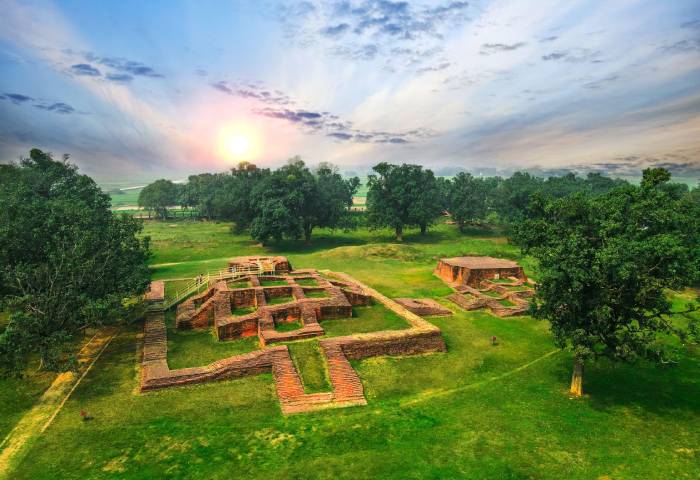
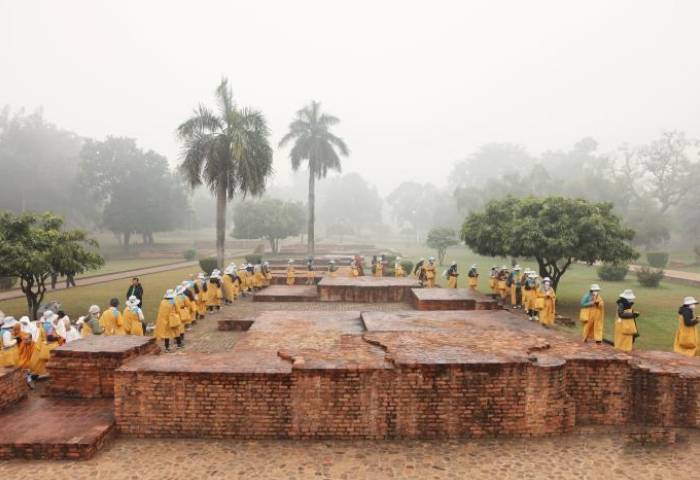
Systematic excavations beginning in 1876 uncovered the Mahaparinirvana Temple and the great reclining Buddha image within it, along with extensive remains of stupas and monastic structures. The site has been progressively restored and developed since then.
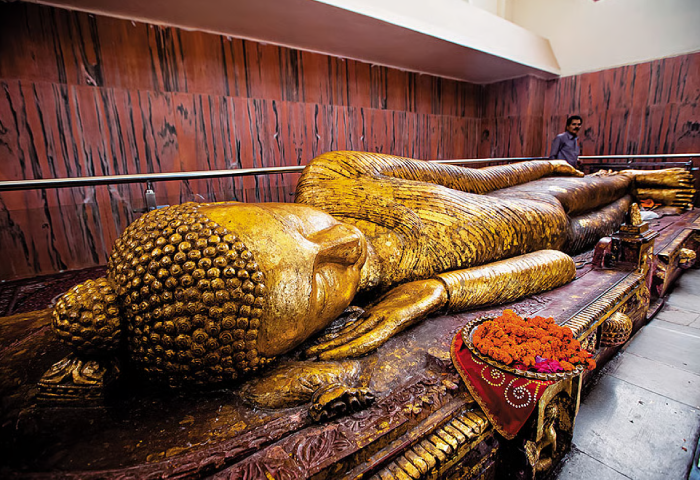
The principal monument at Kushinagar is a temple sheltering a colossal reclining image of Buddha, 6.1 metres in length, carved from a single piece of stone and covered in a gilded robe. The image is dated by inscription to 5th century CE patronage; the temple structure enclosing it has been rebuilt multiple times. The image depicts Buddha in his final moments — lying on his right side, facing west, the classic posture of Mahaparinirvana. Pilgrims leave offerings at the image's feet throughout the day.
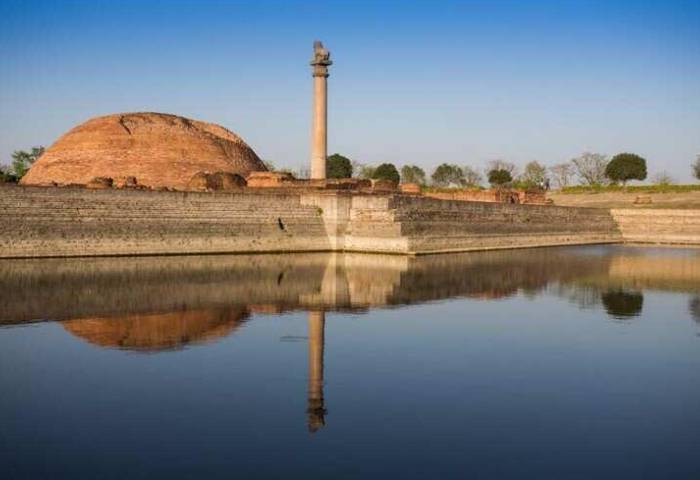
A large earthen mound rising from flat fields approximately 1.5 kilometres east of the main temple complex, the Ramabhar Stupa is identified in the tradition as the Mukutabandhana Chaitya — the spot where Buddha's body was cremated. The stupa, which has been partially excavated and consolidated, is roughly 15 metres high and 34 metres in diameter. It is less visited than the main temple complex, which makes it one of the more quietly affecting places in Kushinagar for those who come there in a spirit of pilgrimage.
Adjacent to the archaeological complex, this small shrine houses a tenth-century CE image of Buddha in the earth-touching posture, seated on a stone throne. The Mathakuar Shrine is identified in Buddhist tradition as the location where Buddha gave his final teaching before passing — though this identification is not universally accepted by scholars.
The magnificent reclining Buddha statue, carved from a single piece of sandstone and draped in a gilded robe, is one of the most revered Buddhist monuments in the world. The sculpture portrays Buddha in his final moments before attaining Mahaparinirvana.
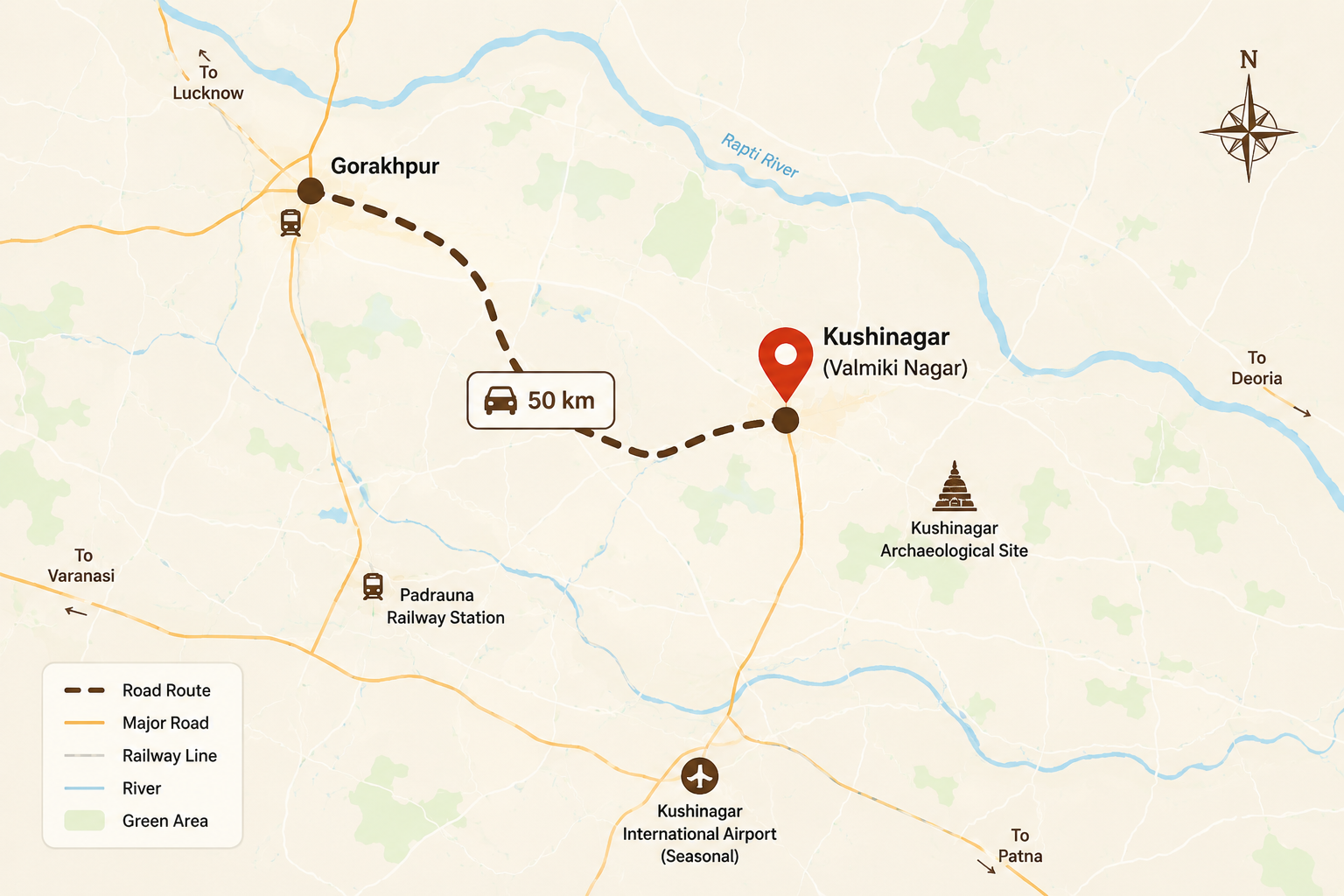
Kushinagar is approximately 50 kilometres east of Gorakhpur in Uttar Pradesh. Gorakhpur is the nearest major railhead, served by direct trains from Delhi, Varanasi, and Kolkata. The nearest airport is in Gorakhpur, with limited connectivity.
Kushinagar itself has a small domestic airport with seasonal Buddhist circuit services. International Buddhist communities — particularly from Japan, Thailand, Myanmar, South Korea, and Sri Lanka — have built monasteries in and around Kushinagar that provide accommodation.