The journey of SIDDHARTHA GAUTAMA a timeless quest for truth, grounded in the sacred landscapes of Asia.
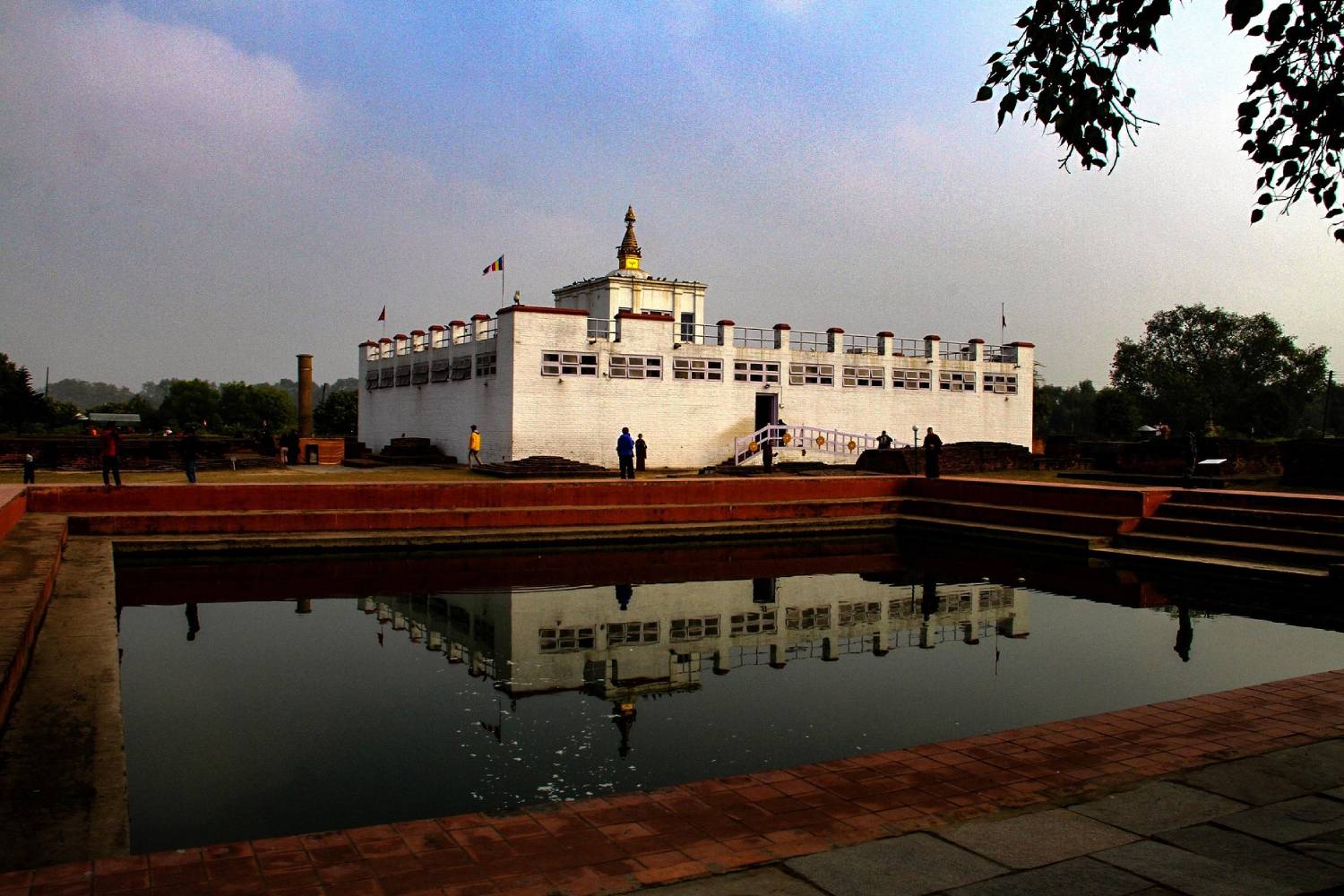
The man who became the Buddha was born as Prince Siddhartha Gautama, heir to the Shakya kingdom of Kapilavastu in what is now southern Nepal. Tradition remembers his beginnings within a royal household, amid cultivated fields, forest groves, and ancient settlements at the edge of the Himalayan foothills. He was born in the sixth century BCE in the gardens of Lumbini, where his mother, Queen Mayadevi, is said to have paused beneath the trees during a journey between Kapilavastu and her ancestral home-Devdaha.
He was given the name Siddhartha Gautama. In later centuries, Buddhist texts would remember signs and prophecies surrounding his birth, among them the visit of the sage Asita, who foresaw an uncommon destiny for the child. Whether preserved as history, devotion, or memory, these accounts reflect the significance later generations would attach to the life that began there.
Siddhartha's mother passed away seven days after his birth, and he was raised within the palace walls under the care of his family. His father, King Suddhodana, held a leading position among the Shakyas and is remembered in tradition for wishing that his son inherit a life of worldly responsibility and leadership.
Yet beyond the settlements and cultivated fields of the Shakya lands lay larger questions—questions that would, in time, draw Siddhartha beyond the life into which he had been born.
Siddhartha spent his early years within the world of the Shakya court, receiving the education and training expected of a young nobleman. Tradition remembers a life of comfort and refinement, shaped by learning, family, and the responsibilities that lay before him. In time, he married Yashodhara, and together they had a son, Rahul.
Yet the sources suggest that Siddhartha's attention was increasingly drawn beyond the rhythms of courtly life. Encounters with old age, illness, death, and a wandering ascetic revealed realities that no privilege could set aside. They awakened a deeper awareness of the impermanence that touches all lives and stirred questions that could not easily be ignored.
Around the age of twenty-nine, Siddhartha left behind the life he had known and set out in search of understanding. Crossing the Anoma River which now set the border between Nepal and India in southern part of Nepal, he exchanged the certainty of his former position for the life of a seeker. In Buddhist tradition, this moment is remembered as the Great Renunciation—a quiet turning point that would shape the course of Buddhist history.
In search of answers, Siddhartha studied with respected teachers of meditation, among them Alara Kalama and Uddaka Ramaputta. He learned their practices and pursued them with dedication, yet came to feel that they did not fully address the questions that had led him from home.
He then settled near Uruvela, in the region of present-day Bodh Gaya, where he spent several years living as an ascetic alongside a small group of companions. Like many seekers of his time, he embraced a life of discipline and renunciation, reducing his needs to the barest essentials. In time, however, he came to understand that neither indulgence nor self-denial offered the clarity he sought. The path, he realised, lay elsewhere.
Legend has it that a young woman named Sujata, who was believed to be from lower caste, offered him a simple meal of milk rice known as Kheer in common parlance in Nepal and India, restoring his strength after years of austerity. Thereafter, he made his way to a fig tree on the banks of the Niranjana River and took his seat beneath its branches.
There, in the stillness of the river plain, Siddhartha turned his attention inward. The tree would later become known as the Bodhi Tree, and the place beneath it one of the most revered sites in the Buddhist world. Though centuries have passed, the Bodhi Tree at Bodh Gaya continues an unbroken lineage of remembrance at the place where the Buddha attained enlightenment.
Buddhist tradition remembers the night beneath the Bodhi Tree as a moment of profound stillness and insight. Through deep meditation, Siddhartha is said to have turned his attention to the nature of existence itself, contemplating the causes of suffering and the possibility of freedom from it. As the night unfolded, understanding gave way to awakening.
By dawn, he had become the Buddha—the Awakened One. The truths he realised beneath the tree would form the foundation of the teachings that followed: an understanding of suffering, its causes, its cessation, and the path that leads beyond it. He was about thirty-five years old.
In the weeks that followed, the Buddha remained in the vicinity of Bodh Gaya. Buddhist texts describe seven weeks spent in quiet reflection at different places around the site, contemplating the significance of what had been realised. These locations, preserved within and around the Mahabodhi Temple complex, continue to be places of reverence for pilgrims who gather there from across the world.
Even today, the landscape of Bodh Gaya carries the memory of those weeks—a place where reflection, insight, and stillness remain at the heart of the pilgrimage experience.
Following his awakening, Buddhist tradition relates that the Buddha spent a period in contemplation, reflecting on the depth of what had been realised beneath the Bodhi Tree. The teachings he had discovered seemed subtle and difficult to express. Yet the same traditions also tell of an appeal from Brahma Sahampati, who urged him to share his understanding for the benefit of those ready to receive it.
The Buddha then journeyed north-west from Bodh Gaya to the Deer Park at Isipatana, near present-day Varanasi, where the five ascetics who had once practised alongside him were living. There, he offered the first teaching of his ministry, a discourse remembered as the Dhammacakkappavattana Sutta—the Setting in Motion of the Wheel of the Dhamma.
In this teaching, Buddha presented the Four Noble Truths and the Noble Eightfold Path, laying the foundations of a tradition that would endure for millennia. The place where this teaching was given is known today as Sarnath, one of the most revered pilgrimage sites in the Buddhist world.
The five ascetics became his first disciples, and with their ordination the Sangha—the community of Buddhist practitioners—came into being. Together, the Buddha, the Dhamma, and the Sangha would come to be known as the Three Jewels, the central pillars of Buddhist faith and practice.
For the next forty-five years, Buddha travelled across the towns, forests, and river plains of northern India, sharing his teachings with all who wished to listen. Kings, merchants, monks, farmers, craftsmen, and wanderers gathered to hear him speak. His teachings took root not in a single place, but across a landscape that remains central to Buddhist pilgrimage today.
Among his early supporters was King Bimbisara of Magadha, who offered a bamboo grove near Rajgir for the growing community of monks. In Sravasti, the merchant Anathapindika established the monastery of Jetavana, which became one of the most important centres of Buddhist teaching. The Buddha returned there often, spending more rainy seasons known as Vassa in Buddhist tradition in Sravasti than anywhere else.
As the community expanded, it also became more inclusive. Buddhist tradition records that Mahapajapati Gotami, the Buddha's aunt and foster mother, sought permission to join the monastic order. Her ordination marked the beginning of the Bhikkhuni Sangha, the community of Buddhist nuns, opening a path that was remarkable for its time.
The Buddha also returned to Kapilavastu, where members of his own family entered the monastic life, among them his son Rahula. In this way, the teachings that had begun beneath a tree at Bodh Gaya gradually spread outward—carried not by conquest or decree, but through conversation, example, and a growing community devoted to understanding the nature of suffering and the possibility of its end.
In the final year of his life, the Buddha continued to travel and teach, moving through the towns and forests of the Gangetic plain as he had done for decades. Near Pava, he became seriously ill, yet pressed on toward Kushinagar. Accompanied by Ananda, his devoted attendant, he made his way to a grove of sala trees on the outskirts of the town.
There, between the trees, a resting place was prepared. Buddhist tradition remembers the sala blossoms as flowering unseasonably, their petals falling softly around him as he lay on his right side, calm and composed. Monks, disciples, and local inhabitants gathered nearby, aware that an era was drawing to its close.
During those final hours, the Buddha continued to offer guidance, answering questions and encouraging his followers to rely upon the teachings rather than any single person. The Mahaparinibbana Sutta preserves his final words:
"All conditioned things are subject to decay. Strive on with diligence."
As night deepened, the Buddha entered Mahaparinirvana—the final passing beyond the cycle of birth, death, and rebirth. Tradition places this event on the full moon of Vesakha, around the fifth century BCE.
His body was cremated at Kushinagar, and the relics that remained were distributed among several kingdoms and enshrined within stupas. Over the centuries, these relics would become objects of veneration and pilgrimage, helping to carry the memory of the Buddha far beyond the lands where he had lived and taught.
Today, Kushinagar remains a place of quiet reflection. Pilgrims come not only to remember the end of the Buddha's earthly life, but to contemplate the impermanence that lay at the heart of his teachings and the enduring influence of a life devoted to understanding it.