BODH GAYA

The Site of Enlightenment

Where Siddhartha Gautama attained complete awakening 2,500 years ago and the path of enlightenment began.

Gaya District, Bihar, India
UNESCO World Heritage Site
Since 2002
Buddham SHARANAM Gachchhami
About Bodh Gaya

The Site of Enlightenment

On the western bank of the Niranjana River in what is now the Gaya district of Bihar, a young man named Siddhartha Gautama sat beneath a fig tree one night some 2,500 years ago and attained complete awakening. That tree — or more precisely, a direct descendant of it, preserved through a continuous tradition of care — still grows in the same location. The temple complex that has grown around it, the Mahabodhi Temple, is among the most significant surviving Buddhist structures in the world. For Buddhists of every tradition, Bodh Gaya is the centre of the earth.

About Bodh Gaya

Historical Significance

The earliest known structures at Bodh Gaya were associated with Emperor Ashoka, who visited the site in the third century BCE and erected a throne (vajrasana) marking the spot of Buddha’s meditation. A sanctuary was built, and the site became a destination for pilgrims from across Asia.

Faxian, the Chinese pilgrim who travelled to India in the early 5th century CE, described Bodh Gaya in detail. The account of Xuanzang, writing in the 7th century, includes a description of the Mahabodhi Temple that corresponds closely to its present structure. The temple was renovated under the patronage of Burmese and Sri Lankan Buddhist communities from the medieval period onward. A major restoration was carried out in the 1880s under British supervision. The Mahabodhi Temple complex was designated a UNESCO World Heritage Site in 2002.

563 BCE

The Buddha attained Enlightenment

249 BCE

Emperor Ashoka visits the site and erected the Vajrasana (throne)

5th century CE

Chinese pligrim Faxian visits

7th century CE

Xuanzang describes the Mahabodhi temple as corresponds closely to its present structure

1880

Major restoration under British supervision

2002

UNESCO World Heritage Site

The Mahabodhi Temple

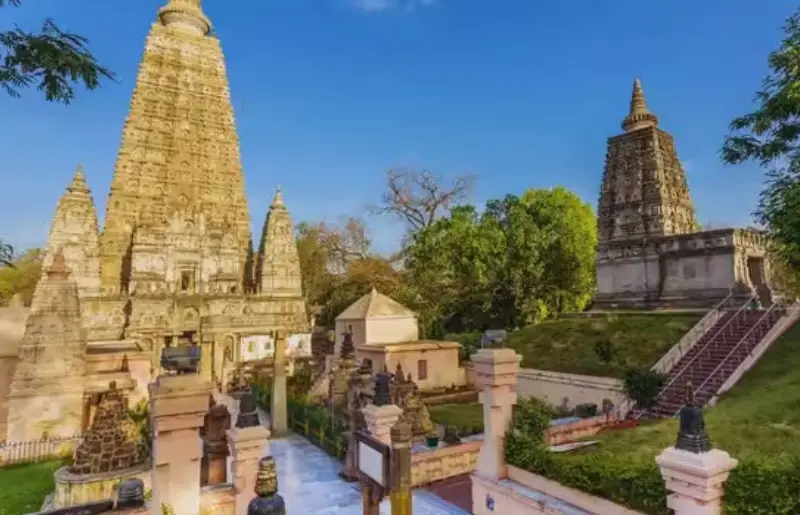
The Mahabodhi Temple is a tall, tapering spire rising approximately 52 metres above the ground, built in a style that combines early Indian temple architecture with later accretions and restorations. Its core is generally dated to the Gupta period (4th to 6th century CE), though the site it occupies has been sacred since at least the time of Ashoka.

The interior of the temple contains a gilded image of Buddha in the earth-touching posture (bhumisparsha mudra) — the gesture associated with the moment of enlightenment, when he called the earth to witness his awakening. The image faces east. Around the main spire, smaller votive stupas and shrines fill the complex, many bearing inscriptions by pilgrims from Sri Lanka, Myanmar, and China from as early as the 7th and 10th centuries CE.

Buddham SHARANAM Gachchhami - The Mahabodhi Temple
Buddham SHARANAM Gachchhami - The Bodhi Tree

The Bodhi Tree

To the west of the main temple, within a railed enclosure, stands the Bodhi tree — a large sacred fig (Ficus religiosa) accepted by tradition as a direct descendant of the tree under which Buddha attained enlightenment. The original tree was reportedly sent by Emperor Ashoka’s daughter Sanghamitra to Sri Lanka in the 3rd century BCE, where it was planted at Anuradhapura, a cutting from the Sri Lankan tree was later returned to Bodh Gaya. Whatever its precise botanical lineage, the tree at Bodh Gaya has been venerated continuously for centuries. Pilgrims sit beneath it in meditation at all hours.

Under this tree, Siddhartha Gautama attained enlightenment, changing the course of human history.

About Bodh Gaya

The Seven Sacred Locations

The Theravada tradition records that after his enlightenment Buddha spent seven weeks at seven locations in and around the Bodh Gaya site, each week devoted to a particular aspect of reflection or practice. These locations are identified in the tradition and partially marked within the Mahabodhi complex. They include the Animisalocana (unblinking gaze) spot, the Jewel Walk (Ratanacankama), and the Ajapala Banyan tree location.

1
Vajrasana

The theone marking the spot of enlightenment

2
Animisalocana

The unblinking pace spot

3
Ratanacankama

The Jewel Walk

4
Ratanaghara

The Jewel House

5
Ajapala Nigrodha

The Ajepala Banyan Tree

6
Mucalinda Lake

The lake where Mucainde protected the Buddha

7
Rajayatana

The place of meditation

The Site of Enlightenment

On the western bank of the Niranjana River in what is now the Gaya district of Bihar, a young man named Siddhartha Gautama sat beneath a fig tree one night some 2,500 years ago and attained complete awakening. That tree — or more precisely, a direct descendant of it, preserved through a continuous tradition of care — still grows in the same location. The temple complex that has grown around it, the Mahabodhi Temple, is among the most significant surviving Buddhist structures in the world. For Buddhists of every tradition, Bodh Gaya is the centre of the earth.

Buddham SHARANAM Gachchhami
Plan Your Visit

Travel Information

Bodh Gaya is situated approximately 12 kilometres south of Gaya city in Bihar, which is served by air, rail, and road. The nearest airport with regular flights is Gaya International Airport. Varanasi is approximately 250 kilometres away by road.

The pilgrimage season runs roughly from October to March, with the Bodhgaya Temple Management Committee regulating access during major festivals, particularly around Buddha Purnima.

By Air Gaya International Airport, (12 km) from Bodh Gaya

By Rail Gaya Junction is well connected to major cities in India

By Road Varanasi (250 km), Patna (110 km), Ranchi (175 km)

Best time to Visit Octaber to March Pleasant weather and festival season

Buddham SHARANAM Gachchhami

Explore More Destinations

Browse our collection of featured destinations and start planning your next journey today.
Vaishali

Vaishali

The Ancient City

Read More
The Extended Buddhist Circuit

The Extended Buddhist Circuit

Walking the Sacred Ground

Read More
Swayambhunath

Swayambhunath

The Self-Arisen Stupa

Read More
Sravasti

Sravasti

Quiet Monastic Groves

Read More
Sarnath

Sarnath

where he delivered his first sermon, setting the Dharma in motion

Read More
Sagarhawa

Sagarhawa

The Forest of the Shakya Massacre

Read More
Ramgram

Ramgram

The Only Undisturbed Relic Stupa

Read More
Rajgir

Rajgir

Hills, Caves & Teachings

Read More
Nalanda

Nalanda

The University of the Ancient World

Read More
Lumbini Monastic Zone

Lumbini Monastic Zone

The International Monastic Zone

Read More
Lumbini

Lumbini

The birthplace of Siddhartha Gautama, around 563 BCE

Read More
Kushinagar

Kushinagar

where he passed into Mahaparinirvana

Read More
Kudan

Kudan

Where the Father Met the Son

Read More
Kapilavastu

Kapilavastu

Early Life of Siddhartha

Read More
Devadaha

Devadaha

The Kingdom of the Queen’s Birth

Read More